
An alarm tells you something changed.
It never tells you why.
Rule-based alarming is standard on a BMS, and on its own it produces a list that is expensive to read: working out what each line means takes time a site rarely has. Automated fault detection and diagnostics is the part that closes that gap — naming the fault, not the symptom.
Six things that have to be true before a diagnosis is worth reading.
What lands in front of an engineer.
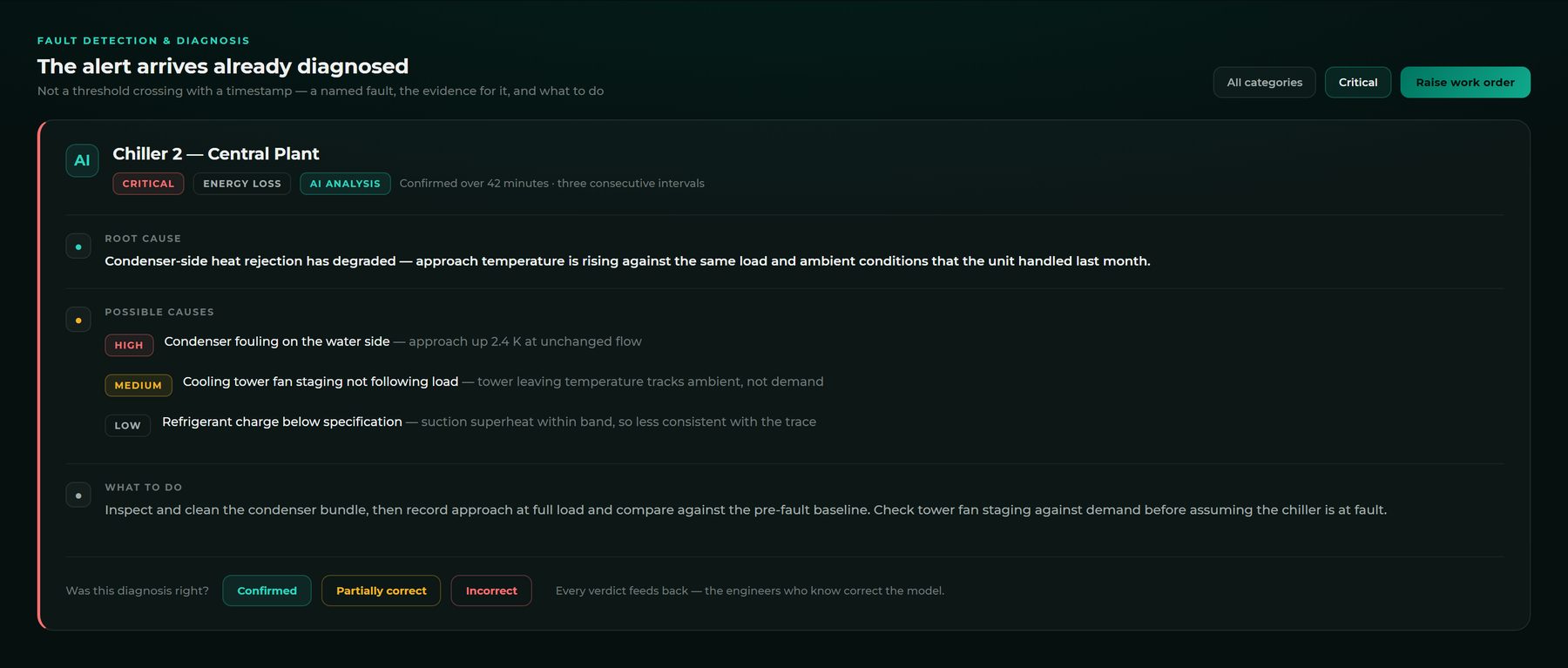
A named fault, its evidence, and what to do about it.
Root cause first, then the causes considered and why each was ranked where it was, then the action. An engineer can disagree with any part of it, because every part of it is shown.
If one asset has it, how many others do?
Search the estate for the same root cause rather than the same alarm text — including the assets still below their alarm threshold, which are the ones worth catching.
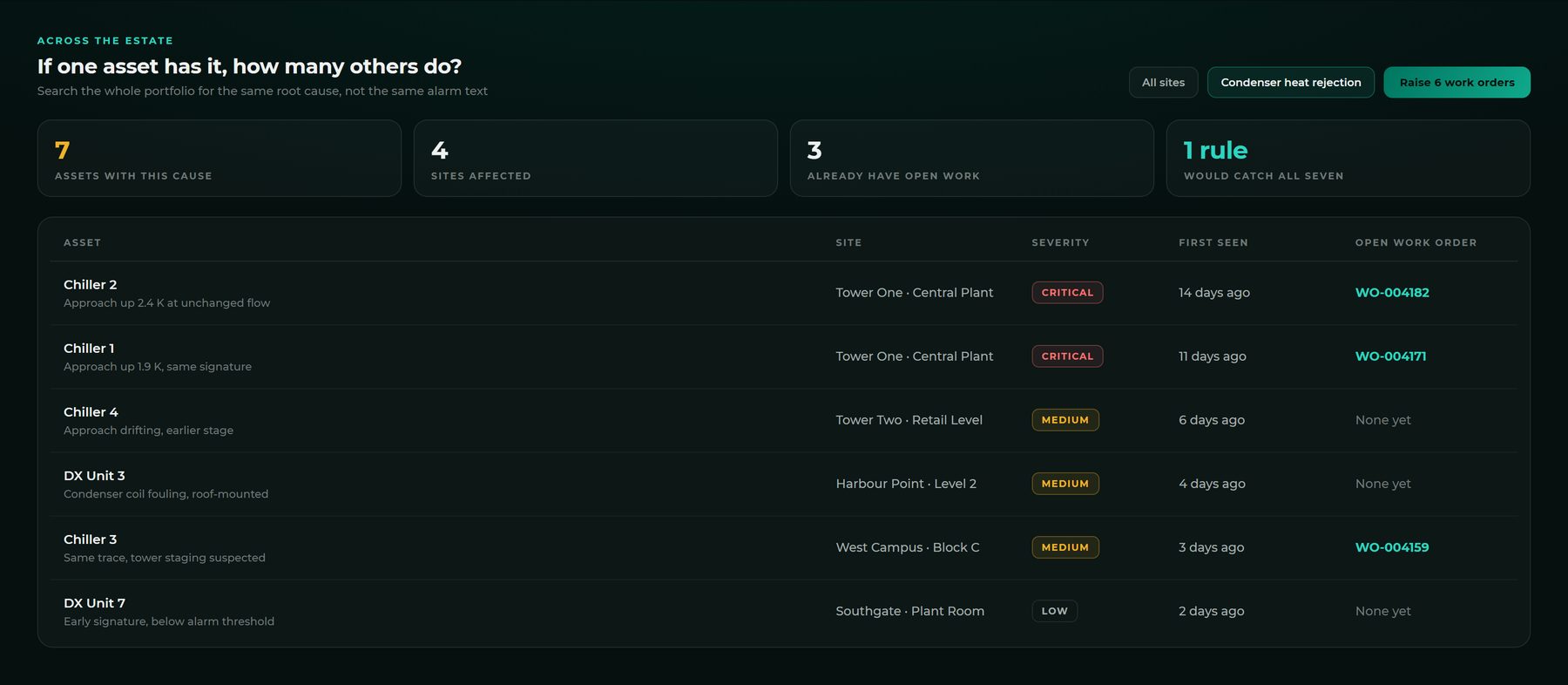
Interface representative. Figures are illustrative demonstration data.
Agents, in sequence, each one checkable.
Validation, confirmation, diagnosis and action are separate steps rather than one opaque model — so when a verdict looks wrong you can see which step produced it.
Intelligence on bad data is not intelligence — it is a confident guess. So the raw signal is cleaned first: drift, stale values, out-of-range readings and flapping are identified before anything is allowed to become an alarm.
A diagnosis nobody acts on is just a better-worded alarm.
Detection only pays for itself at the moment it becomes work — assigned, scheduled, done and verified. That is why fault detection and work management are one product here rather than two, with one asset registry underneath both.
And when the fix was supposed to save energy, measurement and verification is what decides whether it actually did.
- Validated readings before anything is diagnosed from them
- Alarms confirmed across intervals, not on a single spike
- Root cause named and traced through the equipment chain
- Causes ranked by likelihood, each with its evidence
- Engineer verdicts fed back on every diagnosis
- Fleet-wide search for the same cause across the estate
- A work order raised in the same product, evidence attached
The list is not the problem. The reading of it is.
If your estate has more alarms than anyone can triage, the constraint is not detection. What changes the economics is arriving at the fault instead of arriving at the symptom.