
Autonomous should mean
fewer surprises, not more.
Two kinds of autonomy here, and it matters which is which. The agents carry a condition from a raw reading through to a work order with nobody in the chain, but they never write to the plant. Schedules do write: when a unit has drifted off the schedule you set, the correcting value goes back automatically. Both run unattended; only one touches the plant, and the value it writes came from a rule a person wrote. No AI output has ever reached a setpoint, and that is a design decision rather than a gap.
The loop that runs without anyone watching.
This is the autonomous part: agents carry a condition from a raw reading to a work order in someone’s queue, overnight, with nobody in the chain. Each step is a separate stage rather than one opaque model, so a verdict can be traced to whichever step produced it.
The other layer: control, and who authored it.
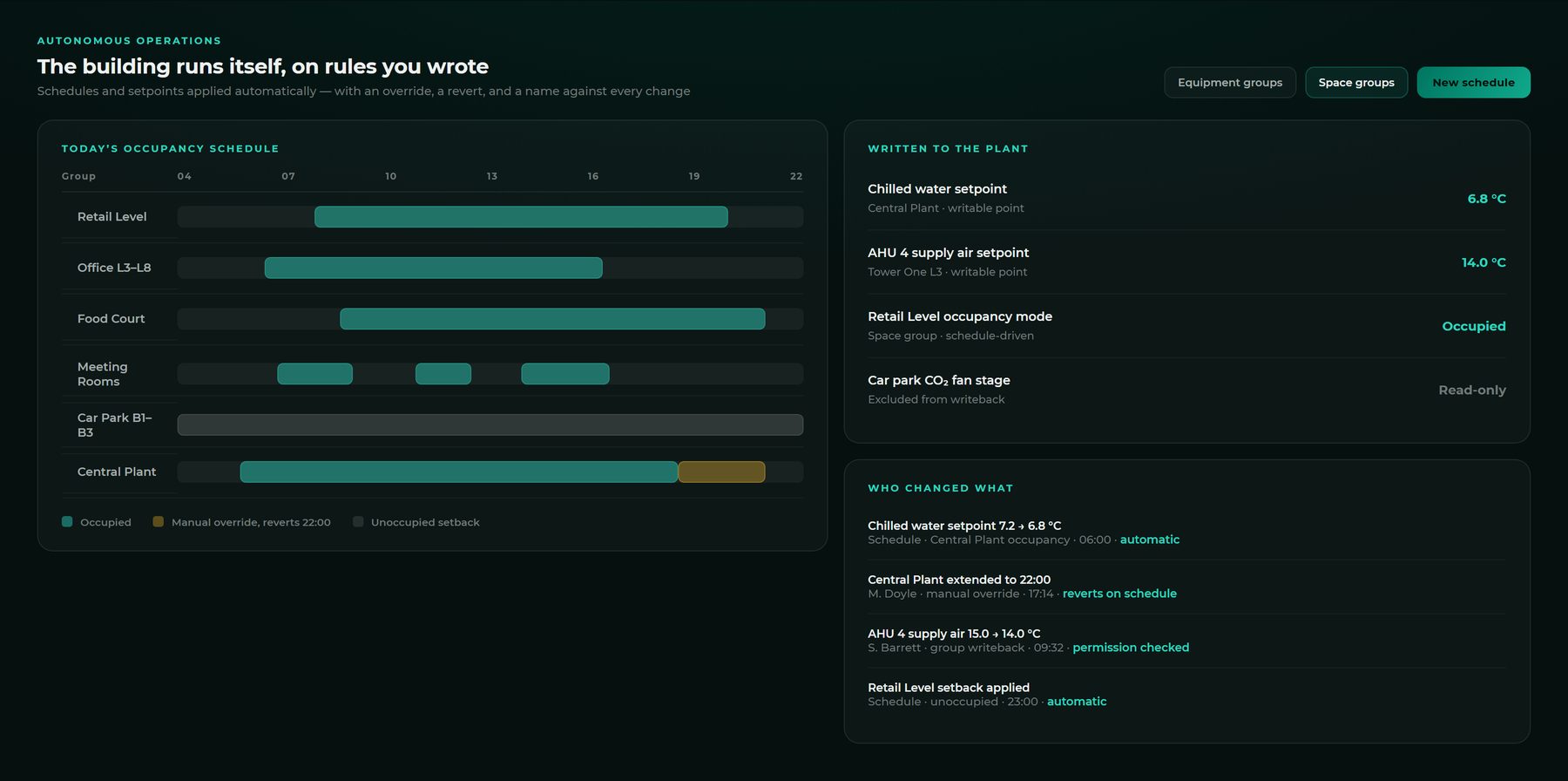
Occupancy schedules per group, the values currently written to the plant, and an attribution log. Where the plant has drifted off its schedule that shows as a violation and the correcting write is queued against it — tracked through to success or failure. Everything here is deterministic: a schedule you wrote, or a person with the permission to write. Nothing on this screen was decided by a model.
The AI does not touch the plant.
It diagnoses, ranks and recommends — and where a fix is a setpoint change, it puts that control next to its own diagnosis so an engineer can act in one place. The engineer still presses it. No model has authority over a setpoint, and none is planned.
On life-safety systems the line is harder still — fire panels are joined listen-only, and nothing is ever written back to them.
Autonomy is only worth having downstream.
A schedule that runs itself saves energy quietly. The rest of the value shows up when a persistent condition becomes a diagnosed fault, that fault becomes a work order, and the saving gets held to a standard instead of asserted.
- Occupancy schedules per Equipment and Space Group
- Setpoints written only to points marked writable
- Permission-gated: viewing and editing are separate rights
- Schedule violations detected and corrected by an automatic write
- Manual override with an expiry, reverting on schedule
- Every change attributed, automatic or manual
- Listen-only on certified life-safety systems
Start with the schedule, not the algorithm
Plant running outside occupied hours is expensive, and it is the kind of loss that accumulates quietly. A schedule is easy to write and easy to lose — someone puts a unit into hand for a callout and it stays there for months. Autonomy that pays is a schedule that is checked against the plant and corrected when it drifts, everywhere, without anyone remembering to look.